
From the Pharmacy Counter
What a Pharmacist Actually Sees When They Read Your List
Handing over a medication list looks like forty seconds of reading. It is a checklist running in a fixed order over the whole list at once. Here is the order, what each pass is looking for, and what to bring so it works.
Written for anyone who would rather understand how the check works than be told to trust it.
The part of the job nobody watches
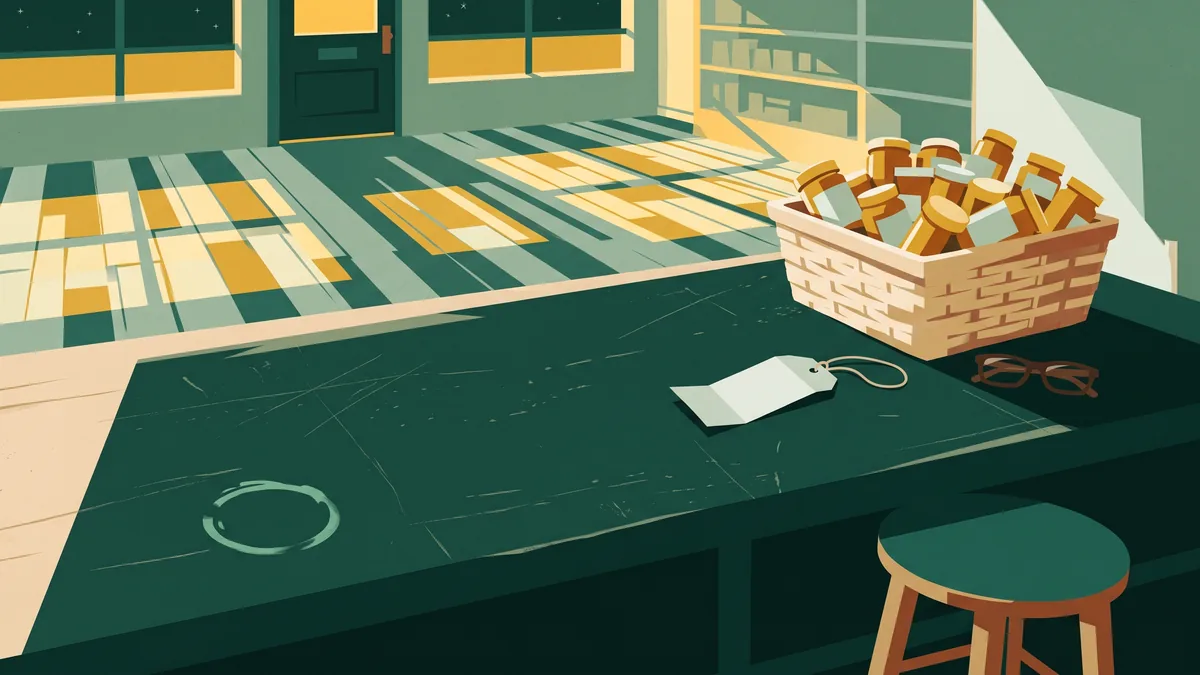
When you hand a pharmacist your list, you are watching someone read for about forty seconds and then say something short. What it looks like from the other side of the counter is a checklist running fast, in a fixed order, on the whole list at once rather than one prescription at a time.
None of it is secret. It is worth knowing mostly because it tells you what to bring, and why the list matters more than any single bottle on it.
First: is anything here doing the same job twice
The first pass is not about interactions at all. It is about duplication.
Two prescriptions can belong to the same family without looking anything alike on the label. That happens honestly and constantly — a hospital stay adds one, a specialist adds another, the original prescriber is never told the first was replaced rather than supplemented, and nobody in that chain ever sees the whole list in one place. You do. Your pharmacist does, if you bring it.
This is the single most common thing a pharmacist catches, and it is the reason a list beats a bottle. One bottle cannot duplicate anything. Nine bottles can.
Second: who prescribed what, and do they know about each other
A pharmacist reads the prescriber names the way you would read a guest list, looking for people who have not met.
Nothing is wrong with having four prescribers. A cardiologist, a primary care doctor, a specialist and an urgent care visit from last spring is an ordinary picture for a person in their seventies. The question is whether the four of them are looking at the same list, and the honest answer is usually that they are not, because there is no single place they all check.
That gap is not anyone's fault and it is not fixed by better doctors. It is fixed by one person holding the whole list — which in practice is you, and the pharmacist you use.
Third: is one of these treating the side effect of another one
This is the one that surprises people, and it is worth understanding as a pattern rather than as a list of examples.
Medications can cause effects the person then goes and gets treated. A new symptom appears, it is real, a prescriber treats it correctly, and now there are two prescriptions where there could have been one change. Read one prescription at a time, this is invisible. Read the list in the order the prescriptions were started, and a shape sometimes appears.
A pharmacist cannot tell you that is what happened, and should not. What they can do is notice the sequence and say it is worth asking about. The asking goes to the prescriber. That is the whole move, and it is a good one.
Fourth: the timing, which people rarely mention
Not what you take. When.
A great many of the practical problems on a medication list are timing problems rather than drug problems. Things that should be spaced apart end up taken together because they are both on the kitchen counter at breakfast. Something that works better at night is taken in the morning because that is when the pill organizer gets opened. Somebody splits their day into two doses and then travels, and the second one drifts four hours.
Timing is also the easiest thing on the list to fix, which is why a pharmacist asks about it early. It usually costs nothing and changes nothing else.
Fifth: what you are not taking
The last pass is the quietest one. A pharmacist looks at the refill dates and works out what is actually being taken.
Nobody says out loud that they stopped one. It is not a confession, and a pharmacist is not there to be disappointed in you. People stop for reasons that make sense at the time — it was expensive, it made them feel worse, they felt better and assumed they were done, or the bottle ran out on a week that was already too full.
Every one of those reasons has a different answer, and every one of them is worth saying plainly at the counter. A pharmacist who knows a medication has not been taken for five months can do something useful. One who assumes it is being taken is working from a list that is not true.
What to bring, and it is less than you think
Not a folder. Not a binder. This:
- Every prescription bottle, or a photograph of each label. Off the bottles, not from memory — the strength is the part people get wrong, and the strength is the part that matters.
- The things that are not prescriptions. Vitamins, supplements, anything bought off a shelf, anything somebody at the gym recommended. These are medications. They belong on the list.
- Anything you take occasionally. Once a week counts. Twice a year counts.
- Anything you stopped in the last year, and roughly when. This is the item nobody brings and the one that most often changes the conversation.
There is no form and no appointment for this at most counters. It is a question asked while something is being filled.
What a pharmacist will not do
Worth saying, because it is the reason the visit is low-stakes.
A pharmacist will not tell you to stop a medication. They will not overrule a prescriber, and they are not trying to. What they do is notice the things that are only visible from the list — the duplicate, the gap between prescribers, the sequence, the timing, the one that quietly stopped — and hand you a specific question to take to the person who prescribed it.
That is the actual output: not a decision, a question. A good one, aimed at the right person.
And the standing rule, here and in everything else we write: do not stop, skip or reduce a medication on your own because of something you read. Take it to the person who prescribed it. If cost is the real problem, say so plainly to both the prescriber and the pharmacist — there are usually more moves available than people expect, and none of the good ones involve stretching a prescription out.
Why we keep saying to ask
Haven Health Plans was started by the pharmacists at Good Day Pharmacy. Good Day operates a network of local community pharmacies across Colorado, Wyoming and Nebraska, and the group is still growing.
So when the site says to ask your pharmacist about us, it is not a slogan about trust. It is a practical instruction that works for an unrelated reason: the person who reads your list that carefully every month is the person best placed to tell you whether an agency is worth ten minutes of your afternoon.
We do not pick plans around pharmacies. A recommendation rests on your medication list, your doctors and your budget. Your pharmacy enters the conversation when you say you want to keep yours.
And the list is the reason the appointment works at all. A plan comparison built on a list read the way a pharmacist reads one is a different exercise from a plan comparison built on a column of drug names typed into a tool. The difference is not the tool. It is the five passes above, done first.
This article describes Medicare's own rules and publicly available community information. It does not describe the benefits of any particular plan, and it is not medical advice: never stop or change a medication without talking to the person who prescribed it. Indexed dollar figures are 2026 figures and reset each January; figures set in statute, such as the insulin ceiling, do not. Hours, fees and schedules for the places named here change without notice, so call before you go.