
From the Pharmacy Counter
How to Build the Medication List We Actually Want to See
The seven things to write down per medication, the four categories people always leave off, and how to build a working list in twenty minutes at your kitchen table.
Written for whoever is keeping the list — your own, or a parent's.
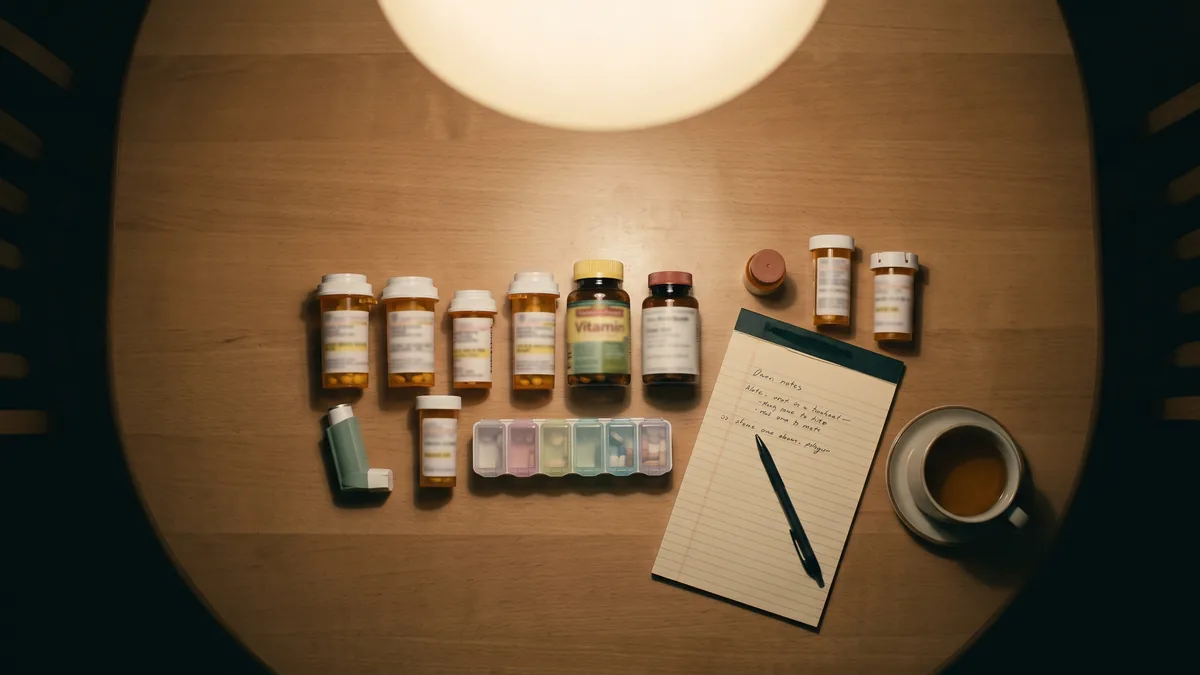
Nothing here is urgent today.
If you are the person keeping the list, whether it is your own or a parent's, you almost certainly already know more about it than anyone else in the family. That is not a small thing and it is rarely acknowledged. What follows is not instruction. It is the checklist we use on our side of the counter, so you can confirm the list you already have is complete.
And if what you have right now is a grocery bag of bottles, that is not a failure either. The list is the one document in a medical life that no single office owns. Nobody has ever been told what a useful one looks like, because nobody is responsible for it.
Here is what belongs on it, and why each piece changes the answer.
The seven things per medication
For every single thing you take, write these down. Not most of them. All seven.
- The name. The one on the bottle, spelled the way it is spelled. If the bottle says one name and your doctor says another, write both. That happens constantly, because most medications have a brand name and a generic name and the pharmacy may dispense either.
- The strength. The number and unit: 25 mg, 100 mcg, 40 units. This is the single most-omitted item and often the one that matters most.
- How much you take, and when. Not "as directed." One tablet twice a day. Two at bedtime. Half a tablet in the morning.
- What it is for. In your own words. "Blood pressure." "The one for my knees." If you do not know, write that you do not know. That is genuinely useful information for us.
- Who prescribes it. Which doctor. This is how we find the medication somebody forgot to tell the others about.
- Which pharmacy fills it. If the answer is more than one pharmacy, that is important. Split lists are where interactions hide.
- How long you have been on it. Roughly is fine. "Years" is fine. "Since the hospital in March" is very useful.
The four categories people leave off
This is where a list goes from decorative to actually useful.
Anything you take that a doctor did not prescribe. Ibuprofen, naproxen, aspirin, acetaminophen, antacids, allergy tablets, sleep aids, stool softeners. These interact. Regular ibuprofen use matters if you are on a blood thinner or a blood pressure medication or have kidney concerns, and it is the single most common thing left off a list.
Vitamins and supplements. All of them, including the ones from the health food store. Fish oil, turmeric, magnesium, vitamin K, St. John's wort, ginkgo, red yeast rice. Several of these have real interactions with prescription medications, and St. John's wort in particular interferes with a long list of drugs. Nobody puts supplements on a medication list because they do not feel like medication. They behave like medication.
Anything you stopped, and why. A medication you quit because it made you dizzy, or because it cost too much, or because you never picked up the refill, tells us more than the ones you are still taking. If cost was the reason, say so plainly. That is a fixable problem, and it is the one we most often can fix.
Anything you take only sometimes. Rescue inhalers. Nitroglycerin. Migraine medication. Antibiotics you have left over. Prednisone you keep for flare-ups. These do not show up in a monthly refill pattern, so they are invisible unless you say them.
Bring the allergy list too
Not just the drug name, but what actually happened. There is a real difference between a rash, an upset stomach, and a trip to an emergency room, and "allergic to penicillin" without that detail closes doors that may not need closing. A stomach ache is an intolerance, not an allergy, and the distinction can matter later.
How to build one in twenty minutes
Do this once and you will not have to do it again for a year.
- Put every bottle, box, tube, inhaler and vitamin jar on the kitchen table. Everything. The cabinet, the nightstand, the glove box, the purse.
- Write down the seven items from each label.
- Add whatever is not in a bottle: the samples, the eye drops, the cream, the injection you get at the office.
- Call your pharmacy and ask them to print your fill history for the past year. Then compare. What is on their list that is not on your table is either something you stopped or something you forgot. Both are worth knowing.
- Take a photo of the finished list with your phone, and keep a paper copy in your wallet.
That last step is the one that pays off in an emergency room at 2 in the morning, when the person asking cannot look any of it up.
What we do with it
We are pharmacists. We read a medication list differently than an insurance agent does, and the honest reason we ask for it is that it is where the money is.
We look for three things.
What it will cost you next year, on paper, on each plan. Not whether a drug is "covered." Covered is not the same as affordable. A plan can list your medication and still charge you several times what the plan next to it charges, because of the tier it put the drug on, the quantity limit attached, or the requirement that your doctor get approval first. Two plans can both cover the same drug and one of them can cost you thousands more.
Whether there is a cheaper version of the same treatment. Sometimes there is a generic. Sometimes there is a different drug in the same class that every plan treats better. That is not our decision to make, it is your prescriber's, but it is a conversation worth having with evidence in hand rather than in January when the bill arrives.
Where the surprises are. A prior authorization that will be denied. A step therapy rule that means you have to fail on something cheaper first. A quantity limit that turns your ninety-day fill into three trips. These are the things that are technically disclosed and effectively invisible until they happen to you.
The pharmacy question, answered before you ask it
Haven Health was started by the pharmacists at Good Day Pharmacy. So it is fair to wonder whether we are going to steer you toward a plan that happens to prefer our own pharmacy.
We do not. Recommendations rest on your medications, your doctors and your budget. If the right plan for what you take means filling somewhere else, we will tell you so. The only time a pharmacy enters the conversation is if you tell us you want to keep yours.
We put that in writing because naming a pharmacy is exactly the thing that should make a careful person suspicious, and the answer should not have to be dragged out of us.
What you get out of it
A finished list is a document you can hand to anyone: a new specialist, an emergency room at two in the morning, a sibling who wants to help and does not know where to start. It ends the conversation where somebody asks what your father takes and four people answer differently.
Bring it to us and we will read it like pharmacists. Bring it to whoever fills the prescriptions and they will do the same, at no charge. Either way the list is yours, and it is the piece of this that nobody else can assemble for you.
And before you call us at all, ask your Good Day pharmacist about us. That is a reference no call center can offer.
This article describes Medicare's own rules and publicly available community information. It does not describe the benefits of any particular plan, and it is not medical advice: never stop or change a medication without talking to the person who prescribed it. Indexed dollar figures are 2026 figures and reset each January; figures set in statute, such as the insulin ceiling, do not. Hours, fees and schedules for the places named here change without notice, so call before you go.